July 2023 San Mateo County Market Update

Rumana Jabeen • July 3, 2023

In this market update, we are sharing a comparison with Q2 2023 and Q1 2023 to show changes in the market over this year. Read below to see the data and our analysis of what’s happened so far in the 2023 Baya Area Real Estate Market.


Median Price vs Appreciation 2023


There are many in the media and even economists who confuse median home price with appreciation. Median price measures the middle-priced homes that were sold, while appreciation measures actual gains or decreases in the value of homes.


The median home price can be influenced heavily by the mix of sales – Let’s look at an example. Let’s say in 2022 there were 5 homes that sold, $200k, $250k, $300k, $350k, and $400k. The median sale price would be the middle number or 300k. In 2022, we saw a 6% appreciation, which means all of those homes increased in value to the following in 2023: $212k, $265k, $318k, $371K, and $424k, respectively.


However, in our example, let’s say that in 2023, only the first three homes sold, or the $212k, $265k, and $318k priced homes. This is a real-world example driven by higher rates, lack of inventory, and other factors that saw more homes on the lower end sold vs homes on the higher end sold.


As a result of this, the median price is now $265k, and when compared to 2022, the median price is down 13%. However, all the homes are higher in price end appreciated by 6%. This is an example to show you how median price can be misleading and not measure true appreciation.


The market dynamics are such that buyer’s affordability has decreased, and demand for homes on the lower-priced end of the market has increased. We have seen over the last several months the median sales price of condos and townhomes have increased, driven in part by demand for homes on the lower-priced end of the market.


Mid-Year Review: Q2 2023 vs Q1 2023


As we reach the middle of the year, now is a good time to look back over the first half of the year. Below we are sharing some key data points as well as providing an explanation of what this means for our local San Mateo County real estate market. This data is focused on single-family home sales in San Mateo County for the period of January 2023 – June 2023.
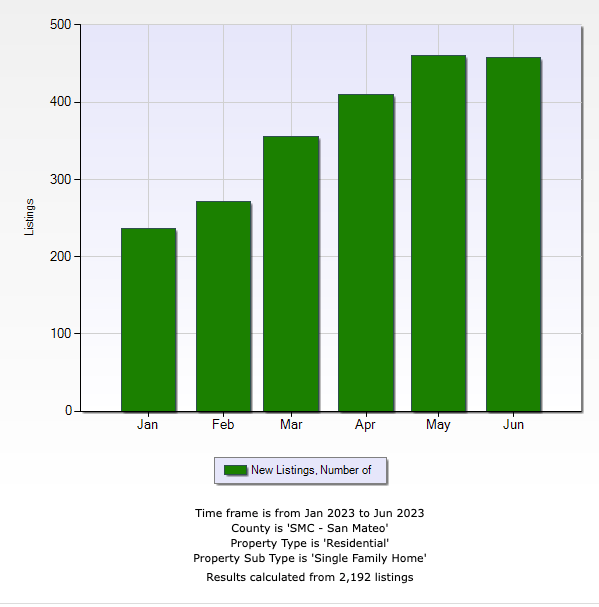

A graph showing the number of listings in each month

Number of New Listings
We saw the number of new listings coming to market steadily trending upwards from January through June. May saw slightly higher new listings coming to market than June. Typical seasonality for our market peaks in April or May, and while this year followed that trend we did continue to see more new listings than expected coming to market in June as well.

Comparing the two quarters, in Quarter 1 (January – March) we saw 863 new listings come to market compared with Quarter 2 (April – June) we saw 1,329 new listings, considerably more inventory, come to market.
A graph showing the number of listings in each month
A graph showing the month of inventory for a single family home

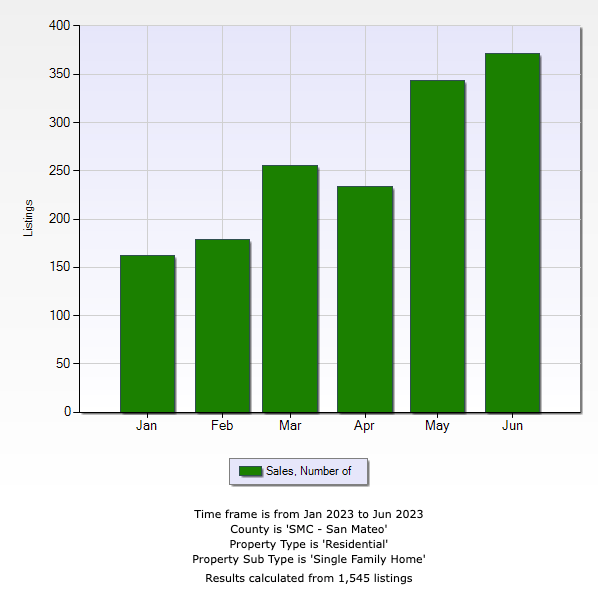
Comparing the Number of Sales with Months of Inventory
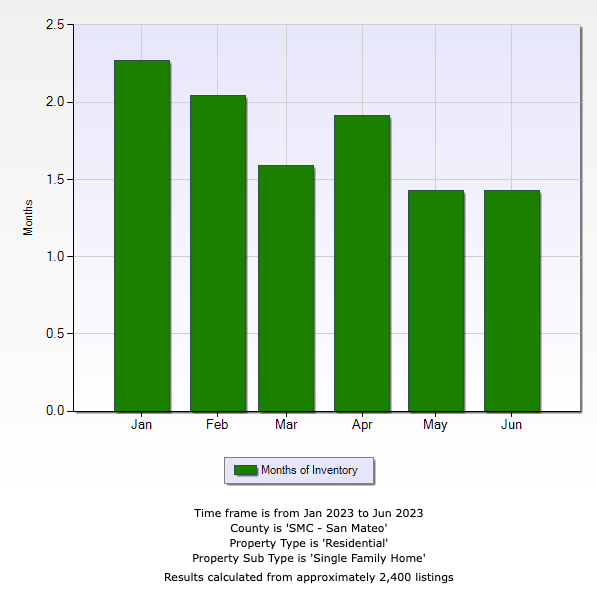
Though few new homes entered the market in January 2023, there was inventory remaining on the market from 2022. As you might expect, this increased our months of inventory – an important marker that showed the balance of the market. While this varies by market, in San Mateo County, more than 4 months of inventory begins to edge into a “buyers” market. In January 2023, we saw 2.3 months of inventory, which is a typical amount of inventory for January in our market.

Starting in February we began to see sales pick up, dipping slightly in April. According to the California Association of REALTORS, “a surge in mortgage interest rates and a shortage of homes for sale suppressed California home sales in April, while the statewide median home price climbed above the $800,000 level for the first time in six months.” However, by May, an
 interest rate reprieve boosts California home sales to the highest level in eight months! That momentum carried on into June.

Comparing the first and second quarters of 2023, in Quarter 1 our market had an average of 2 months of inventory and saw 596 sales, but in Quarter 2 our market had an average of 1.6 months of inventory and saw 949 sales.
A graph showing the number of days to sell a house

Average Days on Market
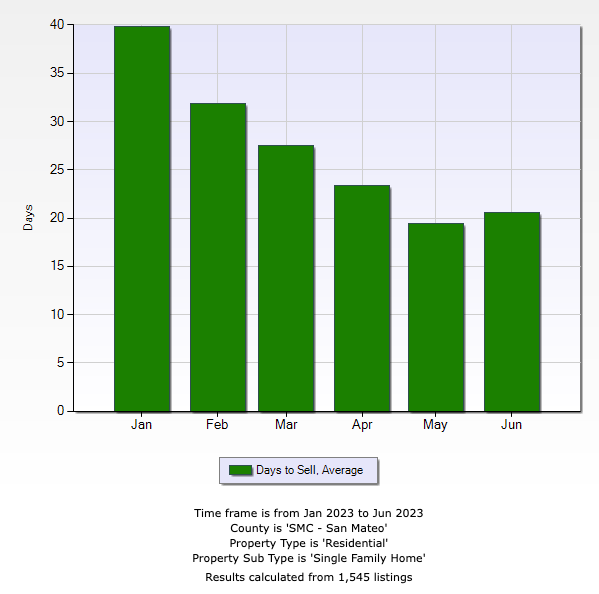
Moving into the year, as more inventory became available the market started to heat up. You can see in the chart above the average days on the market dropped steadily. Even as inventory continued to come to market, it was quickly absorbed.

Comparing the first and second quarters of 2023, in Quarter 1 homes were on the market for an average of 33 days, but in Quarter 2 homes were on the market for an average of 21 days.
A graph showing a percentage of homes for sale

Sales Price to List Price Ratio
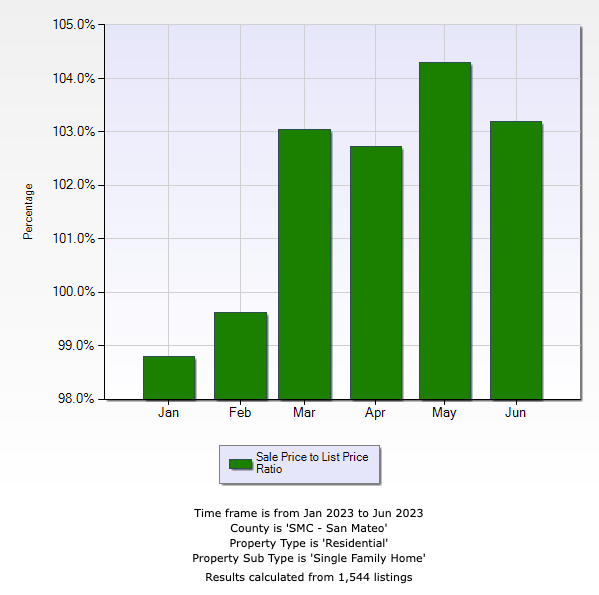
Right in line with the other market factors, as market activity increased so did “overbids” or the amount received when comparing the sales price to the list price.

Comparing the first and second quarters of 2023, in Quarter 1 the average overbid was 100.5%, but in Quarter 2 the average overbid was 103.4%.
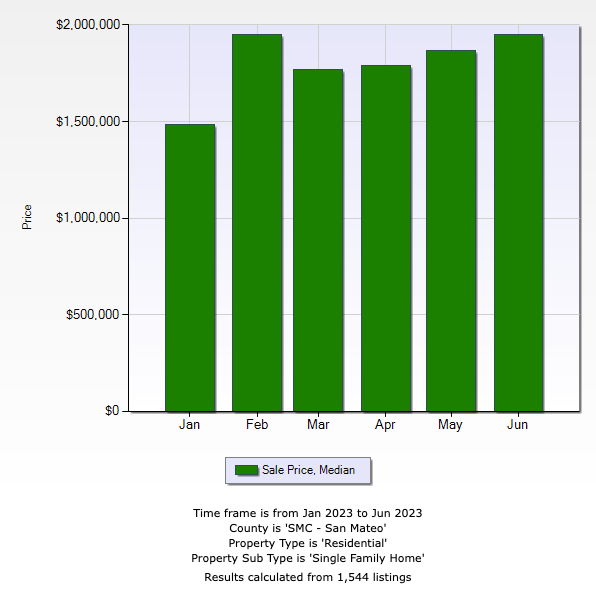
A graph showing the price of a single family home

Above is the Median Sales Price for Single Family Homes for the period of January 2023 – June 2023.

For Quarter 1, we saw a steady rise in Median Sales Prices. During this quarter, the median sales price for single-family homes was $1,767,250. In Quarter 2, the trend continued with the median sales price for single-family homes at $1,790,000.


Our predictions for the remainder of 2023


While no one has a crystal ball, we do have some indicators as well as historical data to understand what might happen in the last half of 2023.

Interest Rates – Interest rates are a huge impact on the market. Most buyers have adjusted, and as long as they stay fairly steady, we believe that activity will continue to accelerate.

Inventory – While we do believe more inventory will become available by the end of July and early August, based on conversations with our peers, new listings will continue to trend in line with similar levels as last year, as high mortgage refinance rates discourage anyone from moving and selling. That will ensure home prices either rise or are resistant to any decline.

Effect on Buyers – Affordability for first-time buyers will continue a downward path as rates stay higher than in recent years and prices continue to edge up.

Pricing and Preparation – As always, the pricing strategy and how a property is prepared for the market will set the stage for how it’s positioned. If you’re considering selling your home, working with an agent who has a proven track record will be key to your success!

Overall, we expect to see a healthy market. While the market is absorbing homes priced at the $2.5M price point and below quickly, there is greater demand for higher-priced homes and even less available inventory. This limited inventory and high demand in all segments will skew more in the seller’s favor.


VIEW THE FULL JULY 2023 MARKET REPORT FOR SAN MATEO COUNTY

Need expert guidance on our local real estate market?


WORK WITH RUMANA
By Rumana Jabeen • October 22, 2026
Rising mortgage rates are changing how buyers approach the market, but not everyone is feeling the pressure equally. Here's what that means for buyers and sellers across San Mateo County. Mortgage rates are climbing again, and naturally, I'm hearing questions about what this means for the Peninsula real estate market. Will buyers pull back? Will home prices soften? Will the demand we've seen throughout the year finally begin to slow? My answer is that it depends on which buyers and which homes we're talking about. Higher interest rates are certainly affecting affordability, but I'm seeing buyers respond in very different ways. Some are reconsidering their budgets or whether to buy at all. Others are bringing more cash to the transaction so they can continue pursuing the homes they want. We're not looking at one market moving in one direction. We're looking at several different markets, each responding to the same pressures in different ways. Buyers Are Changing Their Financing, Not Necessarily Their Goals I recently helped a buyer get into contract who was initially planning to make a substantial down payment. As their stock investments performed well, they decided to sell additional shares and increase their down payment to 48% of the purchase price. Their goal wasn't to purchase a more expensive home. It was to reduce the amount they needed to borrow and keep their monthly mortgage payment comfortable. I'm seeing something similar with another buyer who has a maximum purchase price of $2.6 million. Despite rising rates, they haven't lowered that ceiling. Instead, they're evaluating how much additional cash they can bring to the transaction to offset the higher borrowing costs. These are two examples of something important happening in our market. Buyers with significant financial resources have options that other buyers simply don't. They may have stock investments, substantial savings, or equity from a previous home that allows them to adjust their financing without compromising their home search. With the tremendous wealth being generated in the technology sector, including the potential for additional liquidity from future AI company IPOs, that financial flexibility is particularly relevant in the Bay Area. But not every buyer has those options. One Market, Very Different Pressures For buyers shopping at the more accessible end of the single-family home market, higher rates can change everything. A buyer who was previously comfortable competing for a particular home may now find that the monthly payment stretches their budget too far. Some will lower their price range. Others will reconsider whether homeownership makes financial sense right now. That changes the competitive landscape for sellers, too. If your home is positioned toward first-time or more payment-sensitive buyers, I still expect strong interest when it's priced appropriately. But where you might previously have attracted ten offers, some of those buyers may now be looking at less expensive homes or stepping out of the market. You may still sell above asking, but that doesn't necessarily mean you'll achieve the same premium you might have seen when borrowing costs were lower. At the higher end of the market, particularly around $3.5 million and above, I'm seeing a different dynamic. Many of these buyers have greater financial flexibility and can increase their down payments to manage their monthly obligations. That doesn't make luxury homes immune to changes in interest rates, but it can make their buyers less sensitive to those changes. For sellers, this is why understanding your likely buyer matters so much. The strategies that work for a $1.8 million home may look very different from those for a $4 million home. The Condo and Townhome Question Is Getting More Complicated When single-family homes become less affordable, it's natural to assume buyers will turn toward condos and townhomes. Some will, but I'm not convinced we'll see a significant migration into those property types. In my experience, many buyers who are committed to owning a single-family home would rather wait than purchase something that doesn't meet their long-term needs. There's also another consideration that condo and townhome buyers need to understand. California recently enacted Assembly Bill 2050, which will establish stronger reserve-funding requirements for homeowners associations beginning in 2032. The goal is to help associations maintain sufficient reserves for major repairs and future expenses. For some communities, meeting those requirements could eventually mean higher HOA dues or special assessments. The actual impact will depend on each association's financial position, existing reserves, and future obligations. This matters because a lower purchase price doesn't necessarily translate into a lower cost of ownership. A condo may look considerably more affordable than a single-family home, but buyers need to consider the mortgage payment, property taxes, insurance, HOA dues, and potential future assessments together. I also expect buyers to become increasingly attentive to HOA financial health, which could influence how they evaluate individual properties and communities. That doesn't mean condos and townhomes are bad investments. It means understanding what you're buying has never been more important . What I'd Advise Buyers and Sellers Right Now For buyers : Start with the monthly cost you can comfortably sustain, not simply the maximum purchase price a lender will approve. If you're considering a larger down payment, evaluate that decision alongside your need for cash reserves and financial flexibility. If you're exploring condos or townhomes, read the disclosures carefully, particularly the HOA budget, reserve study, meeting minutes, and any planned assessments. Understand the total cost of ownership before making a commitment. And if higher rates have changed what you can afford, don't feel pressured to buy something that doesn't meet your needs simply because you want to become a homeowner. Sometimes the right strategy is to adjust your search. Sometimes it's to wait. For sellers : Don't assume strong overall buyer demand guarantees the same outcome for every property. The most important questions are who your likely buyers are, how they're financing their purchases, and how changes in affordability affect the price range in which your home competes. A carefully prepared and strategically priced home can still perform exceptionally well. But today's market requires us to understand the financial realities of the buyers we're trying to attract. The Peninsula continues to offer tremendous opportunities, but those opportunities are becoming more specific to each property, price point, and buyer. The best time to start your strategy was yesterday. The next best time is today.
San Mateo county Fall
By Rumana Jabeen • September 23, 2026
For buyers, fall may finally bring more choices. For sellers, those homes are arriving in front of a large and motivated pool of buyers who have been waiting for them.
By Rumana Jabeen • August 20, 2026
Summer didn't bring enough new homes to meet buyer demand. Now, a growing pool of motivated buyers could be setting the stage for a very active fall across San Mateo County. Summer is winding down, and normally this is the point when I look back at the season and see a market that has taken a bit of a breather. This year, I see something different. We did get some new inventory over the summer, but not nearly enough to keep pace with demand, particularly for single-family homes. At the same time, buyers never really went away. Many are financially prepared, motivated, and actively searching, but they simply haven't found the inventory they need. That leaves us heading toward fall with an interesting combination: limited supply, persistent demand, and buyers who are becoming increasingly eager to make a move. I don't know yet exactly how the fall market will play out, but the ingredients are in place for a very active season. Summer Never Delivered the Inventory We Needed Summer usually gives buyers more choices. New listings arrive, activity spreads across more properties, and the market tends to settle into a somewhat more relaxed rhythm. That wasn't really the story this year. Single-family home inventory remained particularly tight across San Mateo County. When desirable homes did come to market, buyers often competed aggressively for them. Since May 1, 1,067 single-family homes have sold across San Mateo County. Of those, 798 sold above their asking price, and 125 sold for at least 120% of asking. That tells me something important. Demand isn't missing. In many cases, buyers simply haven't had enough homes to choose from. We're seeing an even more extreme version of that dynamic in San Francisco, where more than 140 homes sold for at least $1 million above asking during the first half of 2026. That is an extraordinary increase from only eight such sales during the same period last year. San Mateo County is its own market, and I would never suggest that San Francisco's results automatically translate to the Peninsula. But both markets demonstrate what can happen when motivated buyers compete for limited desirable inventory. Where Did All the Buyers Go? They are still here. I'm currently working with three highly motivated buyers who are financially prepared and ready to purchase. Their challenge isn't deciding whether they want to buy. It is finding the right single-family home to buy. And they are certainly not alone. Every buyer who spent May, June, July, and August waiting for the right property does not simply disappear when summer ends. Many carry that search into September and October with even greater motivation. That is the pent-up demand I am watching now. If fall brings a meaningful increase in new listings, we could see that demand spread across a healthier selection of homes. If inventory remains constrained, competition for the best properties could become even more pronounced. Either way, buyers should be preparing now rather than waiting for the fall market to officially "begin." Sellers, You Haven't Missed Your Window For homeowners, I think this is the most important takeaway from the summer. If you considered selling earlier this year but didn't, you haven't necessarily missed your opportunity. In fact, time may be on your side. There is a pool of buyers who have spent months searching without finding the right home. If your property matches what those buyers have been waiting for, coming to market this fall could put you in front of an unusually motivated audience. That does not mean every home will automatically receive multiple offers or sell substantially over asking. The fundamentals still matter. Your price has to match your product. Your home has to be positioned against the other choices buyers have across the Peninsula, not just the house down the street. Presentation, condition, location, and pricing strategy will determine whether buyers see your home as the opportunity they've been waiting for. A strong market can create opportunity, but strategy is what converts that opportunity into a successful sale. Advice for Buyers This Fall If you have been waiting for more inventory, use the remaining weeks of summer to get completely prepared. Make sure your financing is current, know your true comfort range, and be clear about which features are essential versus negotiable. More homes may come to market this fall, but the best single-family properties are unlikely to sit around waiting for you to decide. Patience has been necessary this summer. This fall may require decisiveness. Advice for Sellers This Fall If you have been wondering whether you waited too long to sell, let's change the question. Instead of asking whether you missed spring or summer, ask what your specific home would be competing against if it came to market this fall. That is something we can evaluate now. We can look at recent sales, current inventory, buyer activity, your home's condition, and where it fits within its price bracket. If the opportunity is there, the next few weeks give us time to prepare intentionally rather than rushing to market. Summer left us with fewer homes for sale, not fewer buyers. That distinction could define the fall market. The best time to start your strategy was yesterday. The next best time is today.
By Rumana Jabeen • July 16, 2026
Rumana Jabeen and Burt Tsuei recently compared notes on what they're seeing across Foster City, San Mateo, and the Peninsula. These are the questions they're hearing most often.
By Rumana Jabeen • June 12, 2026
Why understanding your options, and your market, can open more doors than you think.
By Rumana Jabeen • May 9, 2026
Why Some Peninsula Homes Are Getting 20 Offers While Condos Sit Unsold
By Rumana Jabeen • April 20, 2026
This Market Is Not Slow. It’s Selective.  And Pricing Is Driving Everything
By Rumana Jabeen • March 5, 2026
A Small Interest Rate Shift, A Big Market Signal
Rumana Jabeen & Burt Tsuei
By Rumana Jabeen • March 5, 2026
Rumana Jabeen & Burt Tsuei announce their new working relationship.
By Rumana Jabeen • February 7, 2026
Even Though the Market Is Slow,  There Is Still a Lot to Love